|
1885
Wendell McMinn August was born on February 18, 1885 in Rew, PA. His mother
died in childbirth, and at three weeks of age, Wendell was
taken to Brockwayville, PA (later known as Brockway), to live
with his uncle and aunt, Daniel and Ellen (McMinn) Groves.
1907-1911
Wendell August graduated from Bucknell
University in 1907 with a Bachelor of Science Degree. After
two years of teaching mathematics in a private school in
Massachusetts, he gave in to his desire to see something of
the West. After traveling through the far West, and holding
various jobs, he returned to Brockwayville, PA.
1912
Wendell August married Jessie McVean Palmer
in 1912, the daughter of Dr. William and Mary Palmer of
Johnsonburg. Within a few years Wendell became a coal broker,
and also held interests in the Toby Diamond Mine, Fox Ranch,
and L. M. Groves Mercantile Company.
Early 1920’s
Jessie and Wendell August built a home in
the newly renamed town of Brockway, PA. They asked Ottone “Tony”
Pisoni, a blacksmith at Wendell's mine, to hand forge latches
for two doors in their new home. Wendell was impressed with
both the quality and modest cost of Ottone's work, and asked
him if he would like working for him in a new forge making
hand wrought iron wares.
1923
In October, Wendell August, with four
blacksmiths, one of which was Ottone Pisoni as the lead
blacksmith, established the Wendell August Forge. The new
Wendell August Forge produced a line of ornamental hand
wrought iron, which included fireplace andirons, candlesticks,
lighting standards, doorknockers, latches, and railings. and
window and door grills.
1928
James McCausland, who had trained as an
architect at the University of Kansas, joined the Wendell
August Forge, and became the Designer and Operations Manager,
a job that he held until his death in 1958. McCausland is
credited for being the originator of many of the company’s
most popular designs during both the wrought iron and wrought
aluminum periods of the Wendell August Forge. James McCausland
became a significant figure in the development of the hand
forged aluminum industry.
1929
On October 24th the stock market crashed
and the Country moved into the Great Depression. Wendell
August lost virtually everything except the Wendell August
Forge. Six workers continued at the Forge, laboring for six
months without a paycheck in order to finish a contract and
maintain the company and their jobs.
1929-1930
The Pittsburgh based Aluminum Company of
America, Alcoa, was beginning plans for a new research
facility in New Kensington, PA. They asked for bids to create
elaborate aluminum gates for the stone wall surrounding the
Aluminum Research Laboratories. Wendell August Forge acquired
some aluminum bar stock in order to experiment with hand
forging the metal. Ottone Pisoni worked with the metal until
he could bend and twist the metal almost at will. Wendell
August Forge won the bid to create the aluminum gates as well
as the elevator doors inside the facility. The Alcoa gates,
which still stand today, opened the door for the Forge to
receive additional contracts for hand wrought aluminum
architectural installations throughout Western Pennsylvania.
1931
The craftsmen of Wendell August Forge
traveled ninety miles from Brockway to install hand wrought
aluminum grillwork in the Grove City National Bank. The
President of the bank, Edwin J. Fithian, recognized Wendell
August Forge as a company that could help bring new industry
and economic development to the Grove City community. At the
urging of Fithian, Wendell August was invited by the
Commercial Club of Grove City to relocate his Forge to Grove
City, and Fithian invested in the company to facilitate the
move.
1932
The construction of a concrete block
building to house the Wendell August Forge began on Madison
Avenue in Grove City on April 16, 1932. Wendell August's
business plan was to be engaged primarily in doing the type of
remodeling that had been done for the Grove City National
Bank, and, as a side line, to manufacture a line of hammered
aluminum "novelties" such as trays, plaques, and
panels. Articles of Incorporation were signed in June 1932.
Edwin J. Fithian was named President and Wendell August was
designated Vice President.
On Wednesday, July 27, 1932 eight Forge
craftsmen started work in the new Grove City facility: James
DePonceau, Benjamin Formani, Les McLaughlin and his brother
Warren McClaughlin, William Miller, "Tony" Pisoni,
and brothers “Doc” Rossi and Natale Rossi. Die engraver
Louis Donato joined the company a very short time later.
Supervisor James McCausland, Sales Manager Howard Chapin, and
Sales Representative Arthur J. Palmer completed the roster of
the new company. The first known catalog for Wendell August
Forge was effective as of October 1, 1932, and featured items
targeting the luxury market.
1933
Under the stewardship of Arthur J. Palmer,
an experienced Gift Ware Representative, Wendell August Forge
product was already being shown at major gift shows in
Chicago, Philadelphia, Boston, and New York. The line was
being well received and sales were far ahead of what had been
anticipated.
Edward J. Fithian was an active participant
in the Prohibition Party, and his integrity was publicly
challenged because of a purported Beer Mug being made at the
Wendell August Forge. Shortly after that, Fithian sold his
share of the Wendell August Forge to Wendell August.
1936
Wendell August Forge was asked to create
mementos commemorating the “Millionaires’ Flight” on the
Hindenburg air ship that took place at the end of the
trans-Atlantic season. There were seventy-two guests on this
flight who were considered to be among the most powerful and
wealthy men in the United States. The best that can be
determined at this time is that the unusual mementos produced
by the Forge were presented to the guests of that flight.
Pictured is the actual prototype of the
pieces presented to the guests of the Hindenburg on October 9,
this piece is at the Wendell August building in Grove City,
PA.
1937
The Wendell August Forge Catalog for 1937
showed approximately two hundred items and sixty different
motifs.
1941
With American involvement in WWII looming
ever closer, aluminum supplies became difficult to acquire for
non-military use. The Saturday Evening Post carried
cartoons emphasizing the need to conserve and collect aluminum
for the National Defense Program. Civilian use of aluminum was
stopped shortly after the Declaration of War by the United
States that followed the December 7th attack on Pearl Harbor.
1942-1945
During World War II, Wendell August was
forced to shut down the operation of the Wendell August Forge
because all aluminum production was allocated for the
manufacture of military equipment, most particularly aircraft.
In August 1942 Wendell August obtained a
contract to house and feed military personnel at the Madison
Avenue building. These were Navy and Coast Guard men who were
being trained in diesel engine operation at the
Cooper-Bessemer plant in Grove City
1945-1949
By April of 1946, the Wendell August Forge
was back in full operation. Louis Donato did not rejoin the
company following the War, and Natale Rossi assumed the die
engraving duties.
Significant post-war architectural
commissions included a variety of Jewelry stores and about
twenty Bank interiors.
1950-1960
The decade of the 1950’s marked the
beginning of a difficult period for Wendell August Forge. The
combination of a number of factors, such as the slowing of
post-war spending, the increased competition from a rising
number of aluminum giftware manufacturers, and the revival of
the imported goods market all contributed to diminishing
sales. This downward trend in sales for the Wendell August
Forge continued during the 50’s as consumer decorating
tastes shifted to a more modernist style. Many changes to the
company’s product line did little to stimulate sales.
Die engraver, and blacksmith, Natale Rossi,
volunteered to go on the road to seek new customers. He
focused on businesses that were looking for client gifts.
Rossi’s efforts kept the company afloat.
1958 was a particularly difficult year as
it saw the untimely death of Chief Designer and Plant
Superintendent James McCausland. His death deprived WAF of its
primary design source. The product line continued to languish,
and lacked freshness, for several years following McCausland’s
death.
1960-1978
The difficult business conditions of the
1950’s continued for Wendell August Forge through the 1960’s
and into the 1970's. By 1960, the group of skilled craftsmen
had dwindled to eight workers.
In April of 1963 the company’s namesake
and founder, Wendell August, died after suffering a heart
attack while having lunch at a Grove City restaurant.
After Wendell August’s death in 1963, his
son Robert (on the left) owned and ran the company. He opened
a small gift shop attached to the Grove City workshop. This
area had previously served as a “viewing area” where
prospective buyers could view samples of items produced at
Wendell August Forge. Although the retail store was well
received by local Grove City residents, Wendell August Forge’s
corporate business still carried the day.
The basic giftware line continued to
feature the highly simplified forms with small motifs that had
come into use after James McCausland’s death.
In the early 1970’s, at the urging of the
Wendell August Forge Office Manager, Mary Lou McNaughton, the
most important contribution to the company’s product line in
decades, was introduced, Collector's Plates. These limited
edition Collector’s Plates spoke to the popularity of
collectibles in the United States, were well received, and
have continued to be since then.
Mary Lou McNaughton also urged Robert
August to submit information about the Wendell August Forge to
various publishers of Tour Books. Tourists began to plan their
trips to include a visit to the Forge, and eventually Tour
Buses noted the tourist activity and included the Wendell
August Forge in their Western Pennsylvania tours.
1978
In February of 1978 F. W. “Bill” Knecht
III, an eighteen-year veteran with IBM, and a resident of
Youngstown, Ohio, purchased the Wendell August Forge from
Robert August. Before the year was out, Robert August died of
cancer.
1979
Knecht developed a retail operation that
included workshop tours, antique display cases, and other
on-site experiences at the Grove City location. Remodeling the
buildings began, and this first step toward the new Wendell
August Forge was completed that November.
Wendell August Forge received a commission
from the U.S. Arms Control and Disarmament Agency to produce
twelve solid bronze plates commemorating the SALT II Treaty
between the U.S. and Russia. The plates were presented to the
signing dignitaries in Geneva, Switzerland.
Natale Rossi, after a noteworthy career
with the Wendell August Forge that began in the 1920's,
retired in December.
1980
Natale Rossi, the Forge’s Master Die
Engraver for over 30 years, was selected as a recipient of the
prestigious Hazlett Memorial Award for Excellence in the Arts
in Pennsylvania.
Dave Bruck and Steve Adams were recruited
to assume the die engraving.
At the urging of his wife, Connie, Knecht
introduced an annual Christmas ornament, the most commercial
success in the company’s history.
1982
Len Youngo was hired as a die engraver.
1983-1994
This was a time frame in which the Wendell
August Forge dramatically expanded in several directions.
Product lines were extended, new motifs in new directions were
created by Bruck and Youngo, and new marketing efforts were
successful in stimulating sales.
In 1989, Knecht was joined in the business
by his daughter, Debbie, and his son, Will.
Knecht’s daughter, Debbie Fetter, was
responsible for a new consumer catalog designed to enhance the
retail operation.
In a move intended to address the needs of
the corporate market, Wendell August developed a new
business-to-business division.
1994
In July, Wendell August opened an
additional retail and workshop facility in Berlin, Ohio. This
13,000 square foot all open beam timber framed facility was
conceived as potentially a place to visit by design, rather
than just incidentally. Once inside, a visitor can find a
Company Museum, Gift Shop Tour area, and a Forge workshop.
This impressive structure is in the heart of Amish Country
where it is now visited annually by thousands of tourists.
2000
In October of 2000 Wendell August opened a
retail store in the Prime Outlet Mall of Grove City.
***************
The data for this short History was drawn
from "Wendell August Forge: Seventy Five Years of
Artistry in Metal," 1999 by Bonita Campbell, and the
contemporary recollections of Will Knecht, President of
Wendell August.
***************
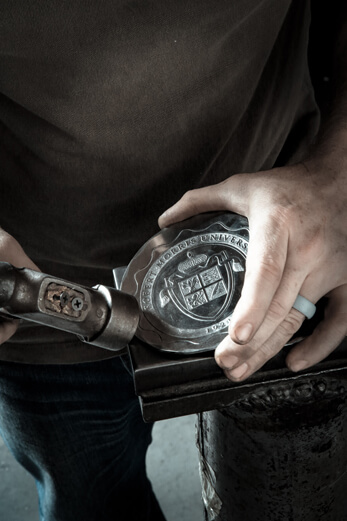
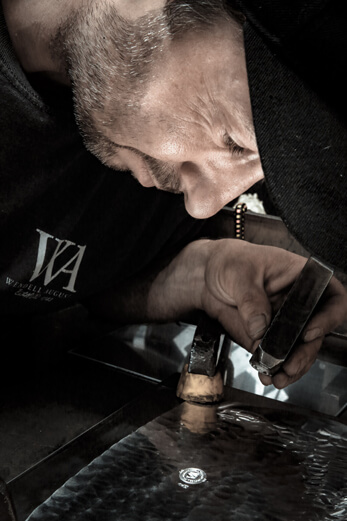
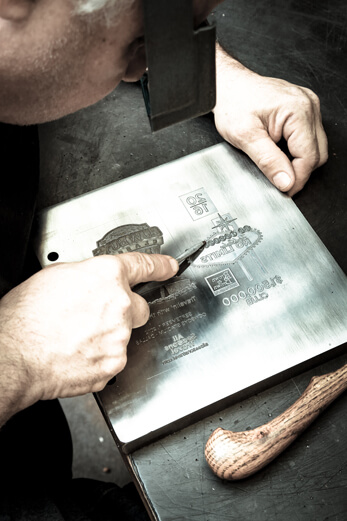
Over the years, there has been considerable change in the
American landscape. At the same time, much at Wendell August
has remained the same. Today, we are proud to continue the
legacy of the artisans and craftsmen who have built our Tradition
of Craftsmanship.
Read more in the definitive history
book on Wendell August.

|